
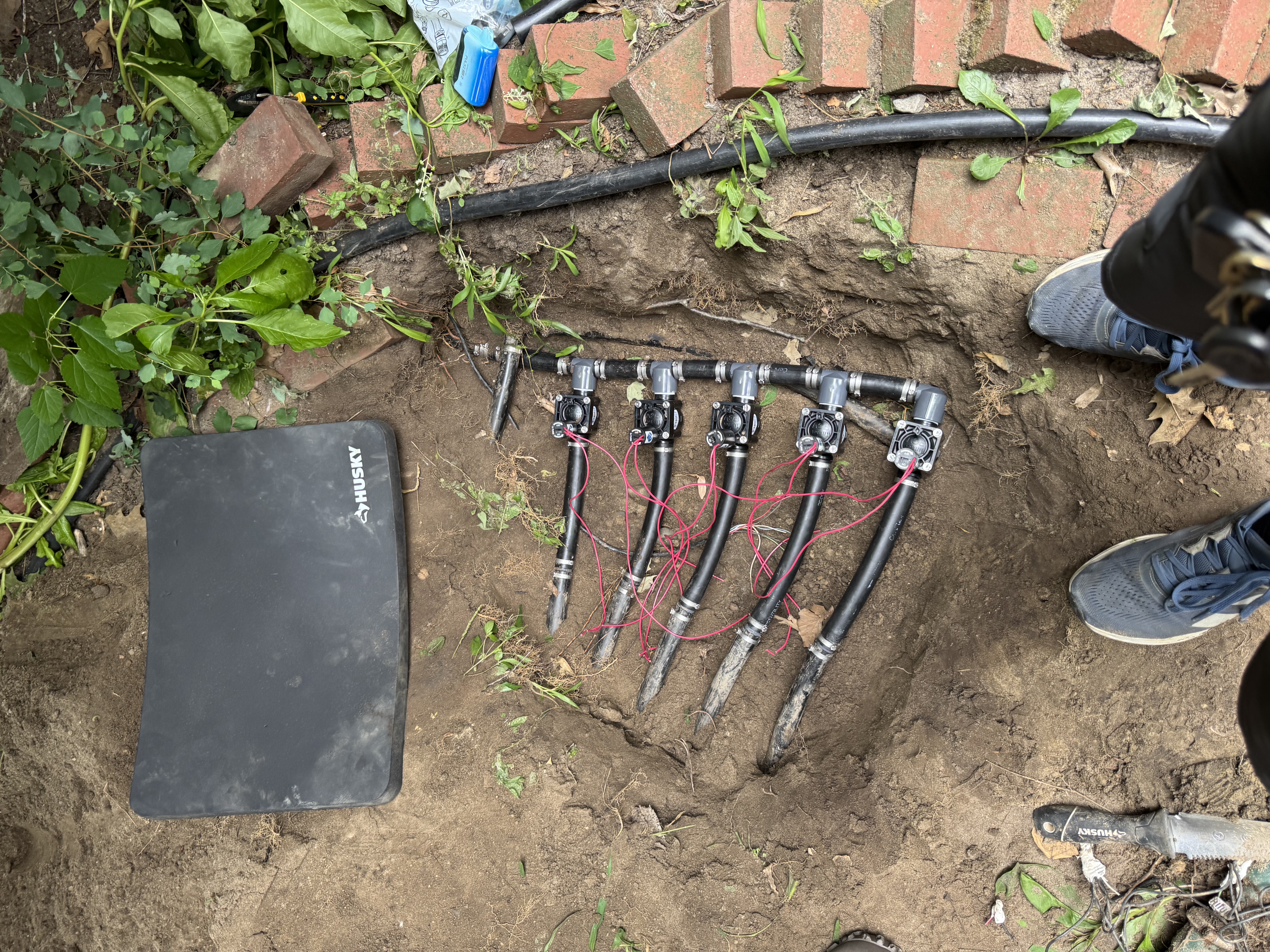
The Hunter PGV is Hunter HydroTech’s preferred residential sprinkler valve. It is used for individual valve replacement, complete manifold rebuilding, and many new residential irrigation applications.
Hunter HydroTech’s preferred residential configuration
- 1-inch valve size
- Globe-body design
- Bolted top rather than jar-top construction
- Non-flow-control residential configuration
- 1-inch male-threaded inlet
- 1-inch poly-barb outlet
Why the male-threaded inlet is useful
The male-threaded inlet connects directly to a 1-inch barb-by-female-threaded manifold tee or elbow. This creates a clean transition from the poly mainline manifold into the valve without unnecessary adapters.
Why the poly-barb outlet is useful
The male-barb outlet connects directly to the polyethylene zone line. The pipe should be fully inserted over the barb and secured with the correct clamp in the proper location.
Why Hunter HydroTech prefers a bolted top
A bolted valve top can be opened in a controlled way for inspection, cleaning, diaphragm replacement, and internal service. The screws secure the top evenly against the valve body.
Hunter HydroTech does not prefer jar-top valves as the primary residential standard.
Non-flow-control residential valves
Hunter HydroTech normally uses non-flow-control 1-inch valves on residential systems. Larger 1.5-inch valves used on commercial or pump-fed systems commonly include flow control.
How a Hunter PGV operates
The controller sends low-voltage power through the station and common wires to the solenoid. The solenoid opens a pilot passage, changing pressure above the diaphragm. Water pressure then lifts the diaphragm and flows into the zone line.
When the signal ends, pressure rebuilds above the diaphragm and the valve should close.
How the PGV is wired
- One solenoid lead connects to the dedicated station wire.
- The second lead connects to the shared white common wire.
- Connections are made with professional waterproof irrigation connectors.
Common Hunter PGV symptoms
- Zone will not activate
- Zone will not shut off
- Valve seeps after shutdown
- Solenoid buzzes
- Controller reports a station fault
- Valve box remains wet
- Valve opens manually but not from the controller
- Valve closes slowly
- Zone pressure is weak or inconsistent
Top or gut service
A newer PGV with a sound lower body may sometimes receive a solenoid, diaphragm, spring, and valve-top replacement.
Hunter HydroTech still generally prefers complete valve replacement when access and budget allow because a gut swap leaves the original lower body, sealing surface, threads, and connections in place.
Complete valve replacement
Complete replacement is preferred when:
- The body is cracked
- The threads are damaged
- The sealing surface is questionable
- The valve is old
- The surrounding fittings need rebuilding
- The work must be warrantied with fewer unknowns
Complete manifold standardization
When rebuilding a manifold, Hunter HydroTech prefers matching Hunter PGV valves rather than leaving a mixture of brands, models, ages, and repair histories.
Manifold fittings
Hunter HydroTech commonly builds residential manifolds with poly pipe and 1-inch barb-by-female-threaded Spears manifold tees and elbows.
The fittings should be straight, level, fully inserted, and free from cracks or stress.
Valve-box layout
- 6-inch round box: one to two valves
- Regular 12-inch box: three to four valves
- Jumbo 14-inch box: approximately five valves
- Eight to ten valves: split across two or three boxes
Mainline flushing before installation
The mainline should be flushed before final assembly, especially after a break, cracked manifold, or repair that introduced dirt. Dirt can lodge beneath the new diaphragm and prevent shutoff.
Hunter HydroTech installation sequence
- Diagnose the original failure.
- Shut off and relieve mainline pressure.
- Excavate and clean the work area.
- Protect open pipes.
- Flush the mainline.
- Install and align Spears manifold fittings.
- Install the PGV in the correct flow direction.
- Connect and clamp the poly outlet.
- Connect the station and common wires.
- Restore pressure slowly.
- Inspect every fitting for leaks.
- Test the valve manually.
- Test the valve from the controller.
- Verify voltage, amperage, ohms, and resistance when required.
- Confirm full opening and complete shutoff.
- Run the sprinkler zone and verify pressure and coverage.
Brand preferences
Hunter HydroTech avoids Orbit, Toro, and generic low-cost residential valves. Rain Bird DV-100 and reputable Irritrol valves are considered serviceable professional products, but Hunter PGV remains the primary replacement and rebuild standard.
Real Project Documentation
Project Photo Gallery
See the diagnosis, repairs, materials and finished work from this Hunter HydroTech project.
Frequently Asked Questions
What Hunter PGV configuration does Hunter HydroTech prefer?
Why does Hunter HydroTech prefer the male-threaded inlet?
Why use a poly-barb outlet?
Does Hunter HydroTech use flow-control PGV valves on residential systems?
Why does Hunter HydroTech prefer a bolted top?
Can a Hunter PGV be rebuilt?
Why standardize a rebuilt manifold with matching PGV valves?
Should the mainline be flushed before installing PGV valves?
What other professional valve brands may be serviced?
Professional Irrigation Service
Need help diagnosing your sprinkler system?
Hunter HydroTech provides residential and commercial irrigation repair, pump-system service, valve diagnosis, controller troubleshooting, backflow service, revamps and seasonal maintenance throughout Southeast Michigan.
Related Sprinkler Repair Guides
How to Install a Residential Spray Head
Learn how to excavate, connect, flush, level, position, test, and backfill a residential spray head.
Read guide →Rain Bird Spray Nozzle Sizes and Patterns
Learn which Rain Bird spray nozzle sizes and patterns Hunter HydroTech commonly stocks for residential irrigation service.
Read guide →Fixed Spray Nozzles vs. VAN Adjustable Nozzles
Compare fixed-pattern and adjustable VAN spray nozzles and learn how opening an adjustable nozzle changes flow, pattern, and effic...
Read guide →