
Underground sprinkler leaks do not always produce an obvious pool of water directly above the failed fitting. Water can travel through soil, follow a trench, disappear into a low area or reduce pressure without creating a dramatic surface break.
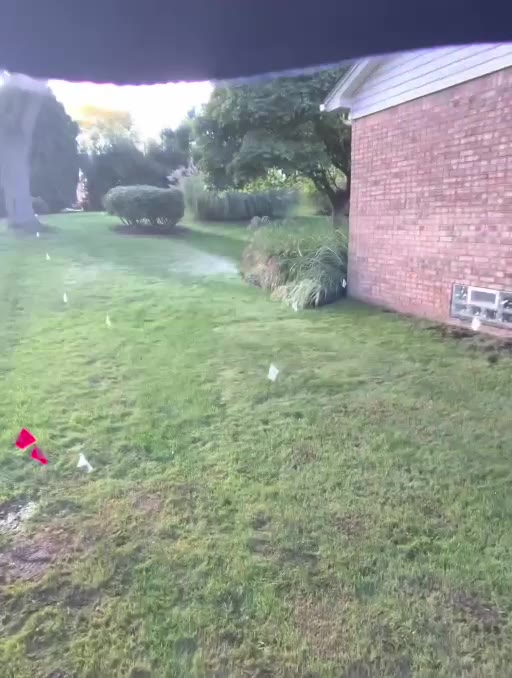
During a recent Rochester Hills irrigation leak-detection job, Hunter HydroTech used controlled air on the affected irrigation line and watched for visible mist escaping from the ground. The mist helped narrow the area where the buried line was losing pressure.
This was a real field diagnostic technique used on this property. It is not a claim that compressed air is the correct leak-location method for every sprinkler system. The water source, valve condition, pipe layout, soil, leak size and accessibility all affect the best diagnostic approach.
The symptom comes first, but it does not identify the failed part
A weak sprinkler zone can be caused by a leaking lateral line, cracked fitting, broken swing joint, partially opening valve, clogged nozzle, excessive zone demand, damaged rotor connection or another hydraulic restriction. Digging at the first wet spot can waste time if the visible moisture is not directly above the actual break.
Hunter HydroTech begins by confirming which station is affected and comparing it with zones that operate normally. That helps determine whether the problem is systemwide or isolated to one valve or lateral.
Using air to create another diagnostic signal
On this Rochester Hills job, air was introduced into the affected irrigation line as part of the diagnosis. Where the buried line was compromised, the escaping air carried moisture and created visible mist at the surface.
That gave the technician another piece of evidence. Instead of opening a large section of lawn based only on an assumption, the visible response helped narrow the excavation area.
Why mist can be useful on the right irrigation leak
Water under normal irrigation pressure can disappear into soil quickly. Air behaves differently. When it escapes through a failed underground connection, it may create bubbling, movement, sound or visible mist depending on how much moisture is already present around the break.
The useful part is not the air by itself. The useful part is combining what the line is doing with the location of the symptom, pressure behavior, valve operation and the known route of the irrigation piping.
Leak detection should reduce unnecessary excavation
A professional diagnosis should narrow the likely repair area before opening more lawn than necessary whenever conditions allow. That does not mean every underground leak can be pinpointed without digging. It means excavation should follow evidence instead of becoming the first diagnostic tool.
Hunter HydroTech's Rochester Hills field history also includes older nylon and spiral-style fittings, legacy valve hardware and older rotor connections. Those components can create below-grade failures that are not obvious from the sprinkler head itself.
Learn more about sprinkler leak detection in Rochester Hills and Rochester Hills sprinkler repair.
Air is a diagnostic tool, not permission to over-pressurize a system
Introducing compressed air into irrigation requires control. More pressure is not automatically better. Valves, fittings, sprinkler heads and other irrigation components can be damaged by careless air pressure or prolonged dry operation.
The purpose during diagnosis is to create useful evidence while respecting the installed system. The technician still has to understand what section of piping is being tested and which components are connected to it.
Why older systems require diagnosis beyond the visible head
Rochester Hills properties can have a modern controller operating field infrastructure installed many years earlier. Replacing a timer does not replace underground fittings, valves, splices or lateral piping. A wet area near a head may therefore originate at a fitting below the head, farther back on the lateral or at another buried transition.
That is why Hunter HydroTech follows the symptom through the complete zone instead of automatically replacing the closest sprinkler head.
Verification matters after the repair
After an underground irrigation repair, the affected station should be operated again under normal water pressure when conditions allow. The repaired area is checked for leakage and the downstream sprinklers are observed for normal rise, rotation, spray pattern and pressure.
A repair is not complete simply because the hole has been filled. The original symptom should be gone and the zone should operate normally.
Rochester Hills local project proof
This diagnostic case is also summarized on RochesterHillsSprinklers.com, a local irrigation resource operated by Hunter HydroTech LLC.
For diagnosis or repair, visit Hunter HydroTech leak detection, sprinkler repair, or book service online.
From the Field
Quick Project Video Clips
Short Hunter HydroTech field clips showing the diagnosis, repair process, installation details or final system testing discussed in this article.
Rochester Hills Compressed-Air Irrigation Leak Detection
Real Hunter HydroTech field footage from an underground irrigation leak diagnosis in Rochester Hills, Michigan.
What you're seeing
The lawn and marked diagnostic area during a Rochester Hills irrigation leak search. Compressed air was introduced into the irrigation line while the area was watched for visible mist that helped narrow the underground leak location.
Real Project Documentation
Project Photo Gallery
See the diagnosis, repairs, materials and finished work from this Hunter HydroTech project.
Frequently Asked Questions
Can compressed air help locate an underground sprinkler leak?
Why not just dig where the lawn is wet?
Can a weak sprinkler zone be caused by something other than a leak?
Does Hunter HydroTech provide leak detection in Rochester Hills?
Should an irrigation line be tested after a leak repair?
Professional Irrigation Service
Need help diagnosing your sprinkler system?
Hunter HydroTech provides residential and commercial irrigation repair, pump-system service, valve diagnosis, controller troubleshooting, backflow service, revamps and seasonal maintenance throughout Southeast Michigan.
Related Case Studies Guides
Shelby Township 2026 Winterization Field Report: City Water, Lake Pump & Well Pump
Hunter HydroTech documents three real Shelby Township winterizations: a 9-zone city-water system near 24 Mile and Van Dyke, an 8-z...
Read guide →Royal Oak Sprinkler Repair After a Recent Revamp: Valve Box, Solenoid & Wiring Failures
Hunter HydroTech diagnosed a Royal Oak irrigation system after a relatively recent revamp developed multiple valve and wiring prob...
Read guide →Warren MI 3-Zone City-Water Sprinkler Winterization Near 14 Mile & Schoenherr
Hunter HydroTech winterized a 3-zone city-water sprinkler system near the 14 Mile and Schoenherr corridor in Warren, Michigan and...
Read guide →