
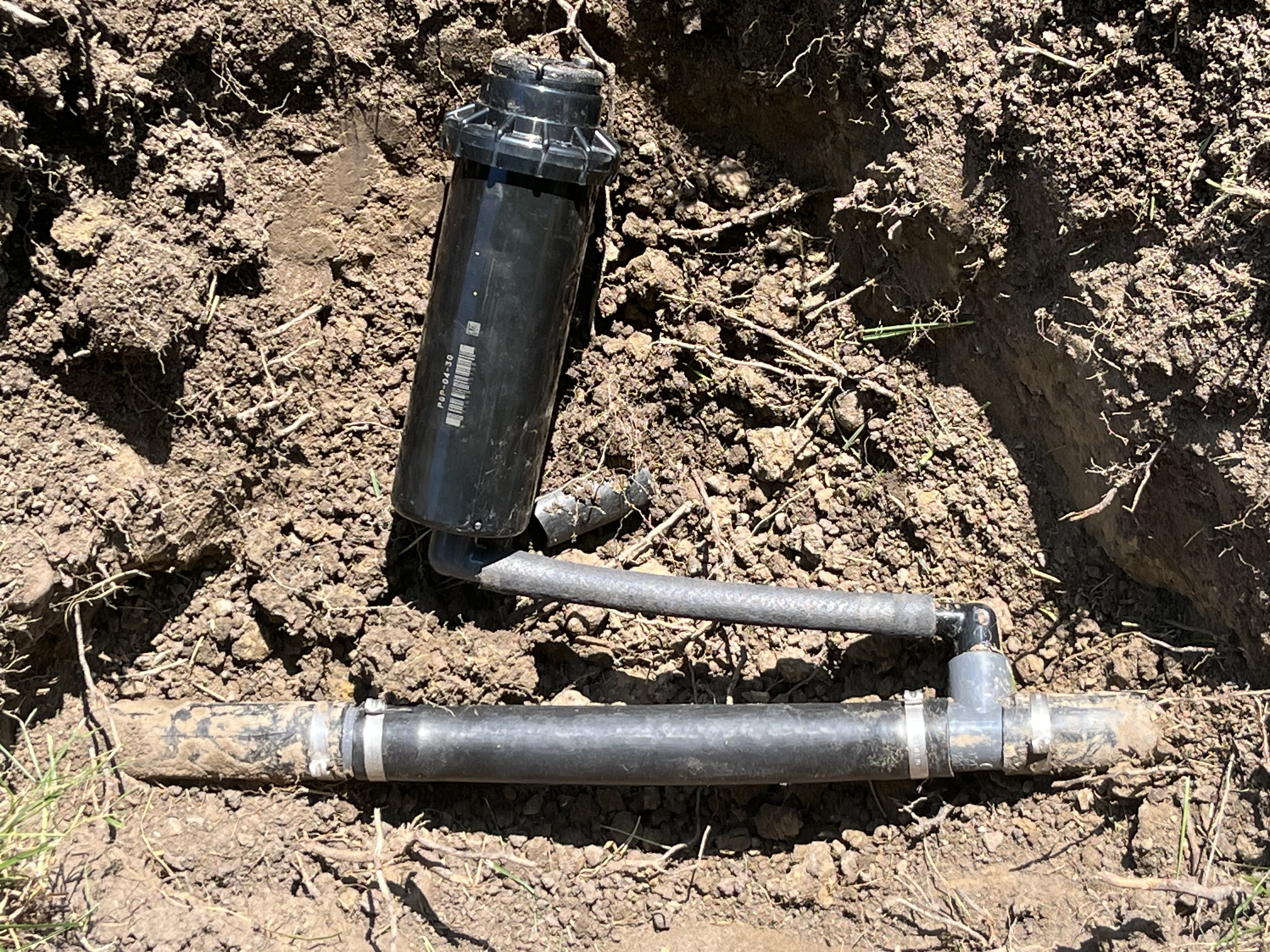
A sprinkler swing assembly is the flexible connection between an underground irrigation zone line and a sprinkler head. Hunter HydroTech normally builds the assembly with two swing elbows and a short section of swing pipe. One end connects to a combination reducing elbow or combination reducing tee in the poly zone line, and the other end connects to the spray head or rotor.
This flexible connection gives the sprinkler head room to move without placing the same stress on the underground fitting that would occur with a rigid nipple. It also makes the head easier to raise, lower, straighten, and reposition when soil settles or landscaping changes.
What parts make up a sprinkler swing assembly?
The exact arrangement depends on the sprinkler head being installed, but a typical Hunter HydroTech assembly includes:
- A CRE or CRT connection at the polyethylene zone line
- A 050 swing elbow at the underground fitting
- Approximately 8 to 14 inches of flexible swing pipe
- A second swing elbow sized for the sprinkler head inlet
- The spray head or rotor
The swing pipe Hunter HydroTech commonly uses is approximately 1/2-inch outside diameter and 3/8-inch inside diameter. We commonly use Rain Bird swing components purchased through professional landscape-supply distributors.
Typical swing assembly for a spray head
A residential spray-head assembly normally follows this arrangement:
CRE or CRT → 050 swing elbow → swing pipe → 050 swing elbow → spray head
The 050 elbow connects to the common 1/2-inch threaded inlet found on many residential spray bodies. The flexible pipe allows the spray body to be positioned at the correct height and kept upright before the excavation is carefully backfilled.
Typical swing assembly for a rotor head
A residential rotor assembly normally follows this arrangement:
CRE or CRT → 050 swing elbow → swing pipe → 075 swing elbow → rotor
The 075 elbow is used at a rotor with a 3/4-inch threaded inlet. The 050 elbow remains at the CRE or CRT when the underground fitting has a 1/2-inch female threaded outlet.
Why use a swing assembly instead of a rigid nipple?
A rigid nipple fixes the sprinkler head in one position. If a mower, vehicle, aerator, heavy piece of equipment, or shifting soil pushes against the head, that force can be transferred directly into the nipple or underground fitting. Older nylon fittings and rigid nipples may crack, split, or begin leaking as they age.
A properly installed swing assembly provides controlled flexibility. That helps with:
- Raising a sprinkler head that has become too low
- Straightening a head that has started leaning
- Repositioning a head after soil settling
- Reducing stress from mower or equipment contact
- Keeping the head connection serviceable during future repairs
How long should the swing pipe be?
Hunter HydroTech commonly uses approximately 8 to 14 inches of swing pipe. The final length depends on the location of the zone line, available working room, required head position, and the amount of movement needed to set the head correctly.
The pipe should not be stretched tightly between fittings. It should have enough length to bend naturally without kinking, but it should not be left in a large, unnecessary loop that makes positioning difficult.
Where should the sprinkler head sit?
Hunter HydroTech normally sets the top of the sprinkler body slightly below the grass while keeping it level with the soil. A useful reference is the beginning of the thatch and grass-root layer. The head should be low enough to reduce mower contact but high enough to rise and distribute water without being buried by soil or thick turf.
When should a nipple be replaced with a swing assembly?
Replacement is worth considering when a head is installed directly on a rigid nipple, especially if the head is leaning, too low, frequently struck, or leaking around the underground connection. A cracked nipple may sometimes be removed with a nipple extractor. If the nipple or female fitting cannot be safely restored, the CRE or CRT may need to be cut out and replaced.
Homeowners can sometimes complete a straightforward head replacement, but deeper excavation, damaged poly fittings, pressurized fitting leaks, or uncertain pipe connections may be better handled by an irrigation technician.
Hunter HydroTech installation standard
Hunter HydroTech prefers commercial-grade swing assemblies for both residential spray heads and rotors. We use professional irrigation parts from landscape-supply distributors such as Ewing Outdoor Supply because we want the underground connection to remain flexible, serviceable, and dependable.
Related resources:
Real Project Documentation
Project Photo Gallery
See the diagnosis, repairs, materials and finished work from this Hunter HydroTech project.
Frequently Asked Questions
What is a sprinkler swing assembly?
How long should sprinkler swing pipe be?
What size swing elbow is used for a spray head?
What size swing elbow is used for a rotor?
Can a swing assembly make a sprinkler head easier to straighten?
Professional Irrigation Service
Need help diagnosing your sprinkler system?
Hunter HydroTech provides residential and commercial irrigation repair, pump-system service, valve diagnosis, controller troubleshooting, backflow service, revamps and seasonal maintenance throughout Southeast Michigan.
Related Sprinkler Repair Guides
Macomb Township MI Sprinkler Winterization: City-Water, Revamped Systems & Pump Shutdown
A Macomb Township winterization guide built around real local irrigation history, city-water shutoffs, rebuilt zones, backflow dra...
Read guide →Royal Oak MI Sprinkler Winterization for Older Systems, Backflows & Legacy Rotors
A Royal Oak winterization guide for older city-water irrigation, mixed-generation rotors and sprays, mature landscaping, backflow...
Read guide →Harrison Township Pump-Fed Irrigation: Berkeley Pumps, Large Mains & Pressure Troubleshooting
Hunter HydroTech field work in Harrison Township includes city-water and pump-fed irrigation, Berkeley 1.5 HP and 2 HP pumps, Hunt...
Read guide →